Concrete Pools
Concrete pools are generally finished with plaster, an age old process of finishing many structures. Used underwater it provides the watertight seal that the more porous shotcrete beneath it cannot. Plaster finishes provide twenty years of service under ideal conditions, however ours is rarely an ideal world. The plaster surface is meant to degrade slowly, eventually requiring a fresh coat.
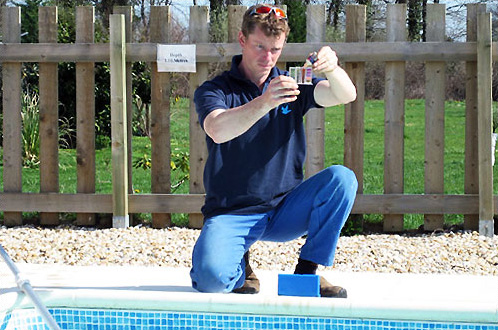
Barring problems in the mixing, application and curing processes, the pool owner controls its condition and life span. Keeping your water chemistry in balance and most importantly, preventing corrosive water environments of low pH and low alkalinity will reduce wear and tear.
Maintain your pH levels at between 7.4 - 7.8
Alkalinity should be kept between 80 - 120 ppm. Lower levels may etch your plaster, which provides a safe harbor for dirt and algae to grow, isn't attractive and is rough to the touch.
Heavy metals cause stains.
Metallic salts cause scale. These salts are primarily forms of calcium and magnesium which can deposit on your plaster, pipes and equipment. They may arise from the use of calcium based sanitizers or the fill water may have high calcium hardness levels.
Keep your calcium hardness levels between 200 - 400 ppm. A level that is above this may find it easy to precipitate out of solution. This is known as a scaling condition. Conversely, water with low levels of hardness will produce an aggressive condition. In aggressive conditions (soft water), the water will take the calcium it wants directly out of your plaster, resulting in plaster breakdown and bond failure.
Common Concrete Pool Problems
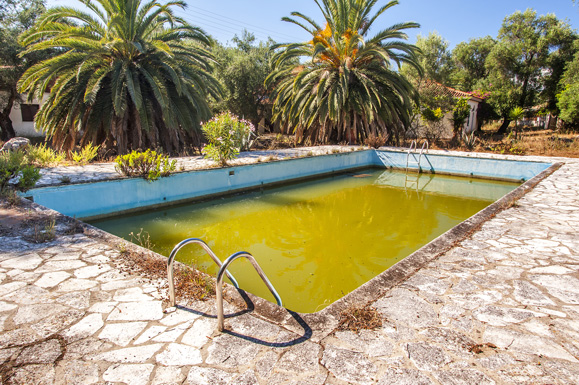
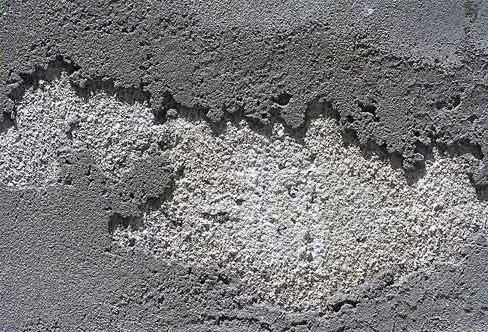
Pool plaster is pitted or etched (see picture below)
If your plaster has surface irregularities, which may take on a beige hue, you have what's commonly called etching. This etching can be caused by low pH or alkalinity; an acidic condition. It may begin within the plaster, from the original mix on application, or etching may start from the concrete side of the plaster and work itself from the outside in.
Pool plaster has large, dark areas
You may be seeing the gunite or shotcrete beneath the plaster beginning to show through. You better start budgeting for that re-plaster.
Pool plaster has small cracks
Known as crazing or checking, the tiny, barely visible cracks are usually caused by extreme temperature variations, especially during initial curing. These are not actually cracks, and pose no structural hazard or danger of leaking. Acid washing could remove the crazed layer. Larger cracks should be cut out in a butterfly or dovetail fashion with a 4" or 7" grinder, and filled with a plaster patch mix or a flexible sealant can be used where further movement is suspected.
Fiberglass Pools
Fibreglass Pool Maintenance Tips
The "bathtub" ring which forms on the pool wall is caused by body oils, suntan lotions and air borne contaminants and can easily be removed with swimming pool tile cleaner or other non-abrasive commercial tile or vinyl cleaners. Do not use abrasive cleaners, steel wool, metal scrapers, brushes or tools as these may cause permanent damage to the gel coat finish. Dulled gel coat above the water line may be restored with a heavy cut automotive polishing compound either power or hand applied followed by a coat of wax. The gel-coat finish of your fibreglass pool can be scratched like any other gloss surface. The gelcoat is seven to eight times thicker than a normal coat of paint so it is not likely that scratches will be more than superficial.
Hair line cracks which may develop over a period of time are not uncommon. They only penetrate the gel coat and do not effect the pool's structure or result in leakage. Scratches and hair-line cracks are repairable. Contact your fibreglass pool dealer for more information. Most of the dirt and debris that sinks to the bottom of your pool can be brushed toward and into the main drain and will be trapped in the filter. Heavy amounts of dirt and debris should be vacuumed out.
Never drain your fibreglass pool!
Your fibreglass pool is designed to remain full of water at all times. If the pool is drained without proper directions, hydrostatic or ground pressure outside the pool could cause the structure to buckle or crack. All damage to the pool shell resulting from improper pool drainage is the owners responsibility. If it becomes necessary to drain the pool contact your fibreglass pool installer or the manufacturer.
Painted Pools
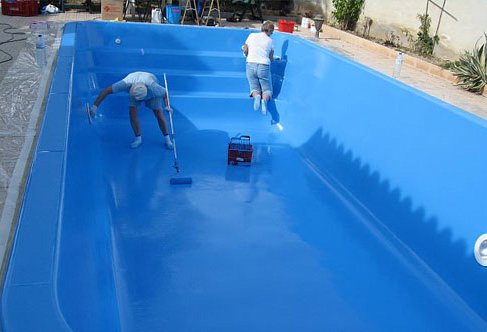
One of the most common pool surfaces is paint. Pool paint comes in many different colors, and is an inexpensive coating compared to other surfaces.
There are three types of pool paint:
Epoxy paint - for new constructions and pools painted previously with epoxy paint. It is long lasting, durable and will stand up to UV rays, automatic pool cleaners and chemical treatments. Epoxy paint will last about 7 - 10 years.
Chlorinated rubber base is not as durable or expensive as epoxy paint but is dependable, easy to use and relatively inexpensive. It is easy to apply, comes in many colours and will last about 3 to 5 years.
Water based acrylic pool paint can be used on any type of surface, is easy to apply and cleans up with water. This type of pool paint is ideal for commercial applications that are repainted on a regular basis and should last about 2 - 3 years.
Common Painted Pool Problems
My Pool Paint is Fading
Painted pools will begin to fade over time, nothing will stop this but you can “brighten-up” the paint with a light acid wash. Acid will remove any dirt and chalking that can dull a paint job. After cleaning the pool with a light solution of muriatic acid and water rinse and refill the pool.
My Pool Paint is Chalking
Some painted surfaces will begin to break down over time. The results can be dull, hazy water, as well as a white powdery residue that can rub off on hands, feet and bathing suits. To avoid this, water chemistry and maintenance are the key. The total alkalinity must be in the correct range, if the alkalinity is too low the pool paint will rub off. Harsh shock treatments will also cause the pool paint to chalk. Use lithium or a di-chloro base shock for maintenance. Harsh shock treatments like calcium hypochlorite will contribute to the deterioration of the pool paint job.
My Pool Paint has Blisters and Bubbles
Blistering is almost always caused by improper preparation. The pool paint must be applied to a clean dry surface. If the paint is applied too thick, or if the surface is too hot or warm, or if the pool is not cleaned properly, it will blister. Application temperature will also affect the final result. The only thing to do is repaint the pool or the spots that have blistered.